

Getting your first salary can feel like financial freedom.
For the first time, you have money that is completely yours. You can order food, shop online, travel, upgrade your phone, pay your bills and finally buy the things you have been waiting for.
Then comes the end of the month.
You check your bank account and wonder:
“Where did all my money go?”
If this sounds familiar, you are not alone.
Managing money is not necessarily about earning a huge salary. It is about having a simple system for deciding where your money should go before you start spending it.
Good salary management can help you pay your bills, enjoy your lifestyle, build an emergency fund, manage EMIs, save for important goals and start investing for the future.
And you don’t need a complicated spreadsheet or a finance degree to get started.
In this guide, we’ll explain how to manage your salary step by step, with practical examples for ₹30,000, ₹50,000 and ₹1,00,000 monthly take-home salaries.
Important: The examples in this article are educational illustrations, not personalised financial advice. Your ideal budget depends on your income, location, family responsibilities, debt, goals and risk tolerance.
First: Budget Your Take-Home Salary, Not Your CTC
One of the biggest mistakes beginners make is creating a budget based on their CTC (Cost to Company).
Your CTC may include components that don’t arrive in your bank account as spendable cash, such as employer contributions, benefits and other components of your compensation.
For everyday budgeting, the more useful number is your monthly take-home pay — the amount that actually reaches your bank account after applicable deductions.
For example:
| Salary Information | Amount |
|---|---|
| Annual CTC | ₹8,00,000 |
| Monthly CTC equivalent | ₹66,667 |
| Actual monthly take-home | ₹58,000 |
| Budget should be based on | ₹58,000 |
The exact take-home amount varies depending on your salary structure and deductions.
Simple rule: Build your monthly spending plan around the money you can actually use.
Step 1: Give Every Rupee a Job
The easiest way to improve salary management is to stop thinking about your salary as one large amount.
Instead, divide it into different purposes.
A simple structure is:
1. Needs
Expenses you must pay to maintain your basic lifestyle.
Examples:
- Rent
- Groceries
- Electricity
- Internet
- Transport
- Essential medicines
- Insurance premiums
- Necessary EMI payments
2. Wants
Things that make life enjoyable but aren’t essential.
Examples:
- Eating at restaurants
- Shopping
- Movies
- OTT subscriptions
- Gaming
- Weekend trips
- Premium memberships
3. Savings & Financial Goals
Money that helps your future self.
Examples:
- Emergency fund
- Short-term savings
- Retirement savings
- Investments
- Goal-based savings
- Additional debt repayment
A popular starting framework is the 50/30/20 rule, where roughly 50% goes toward needs, 30% toward wants and 20% toward savings and investments. Current Indian personal-finance sources also emphasise that this should be treated as a framework rather than a rigid law because rent, EMIs, family obligations and city-specific living costs can significantly change the appropriate split.
Step 2: Try the 50/30/20 Rule — But Don’t Worship It
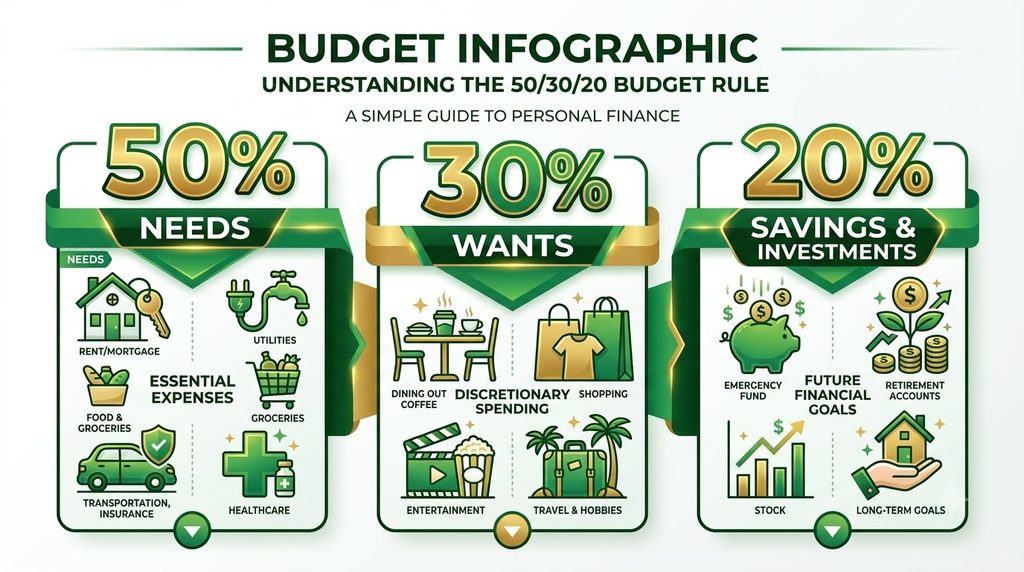
The 50/30/20 rule is a useful starting point for beginners.
| Category | Target | ₹50,000 Salary |
|---|---|---|
| Needs | 50% | ₹25,000 |
| Wants | 30% | ₹15,000 |
| Savings & Investments | 20% | ₹10,000 |
| Total | 100% | ₹50,000 |
But here’s the important part:
Your budget doesn’t have to perfectly follow 50/30/20.
Suppose you live in Mumbai, Bengaluru, Delhi or another expensive city and your rent consumes a large portion of your income. You may temporarily have something closer to:
60% Needs + 20% Wants + 20% Savings
That’s not failure.
The goal isn’t to win a budgeting competition.
The goal is to make sure your spending is intentional and that you’re consistently moving toward financial stability.
Step 3: Separate Needs From Wants
This sounds simple, but it can completely change your spending habits.
Ask yourself:
“If I don’t buy this today, will something important stop working?”
If yes, it is probably a need.
If no, it may be a want.
Example
| Expense | Category | Why? |
|---|---|---|
| Rent | Need | Essential housing |
| Groceries | Need | Basic requirement |
| Electricity | Need | Essential utility |
| Office commute | Need | Required for work |
| Netflix | Want | Entertainment |
| Weekend restaurant | Want | Lifestyle |
| New headphones | Want | Non-essential |
| Emergency savings | Financial goal | Future protection |
There can be grey areas.
A smartphone might be essential for someone whose job depends on it, while upgrading from a perfectly functional phone to the latest model may simply be a want.
The important thing is not the label.
It’s being honest about the reason you’re spending.
Step 4: Save Before You Spend
One of the most powerful money-management habits is:
Pay yourself first.
Don’t wait until the end of the month to see what is left.
Because usually, nothing is left.
Instead, decide your savings amount when your salary arrives.
For example, if you earn ₹50,000 and want to save ₹10,000:
Salary arrives → ₹10,000 is moved to savings/investments → remaining ₹40,000 becomes your spending budget.
This is often easier than spending ₹50,000 and hoping to somehow save whatever remains.
You can automate this using standing instructions or automated investment contributions where appropriate.
Step 5: Build an Emergency Fund
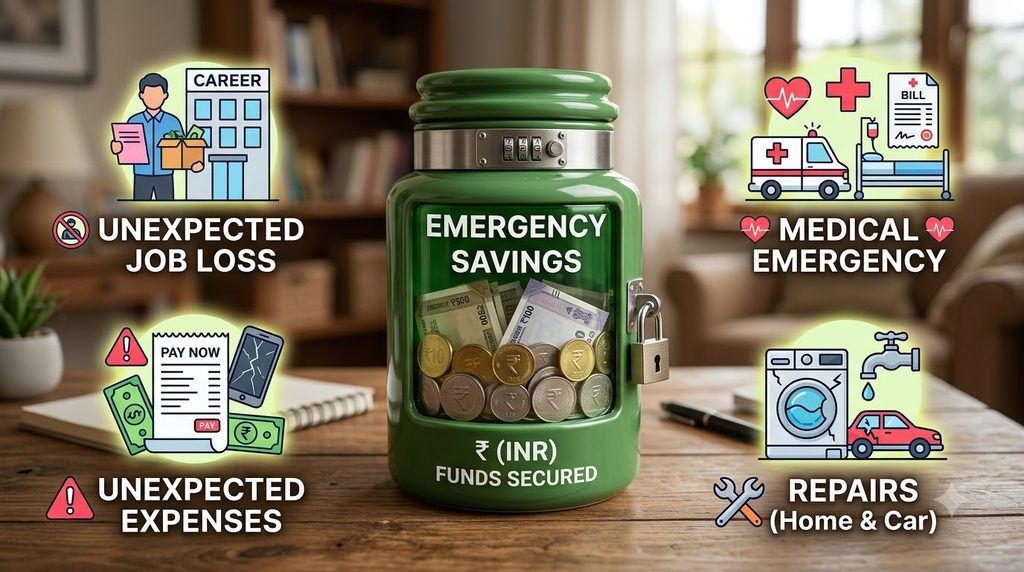
Before aggressively chasing long-term returns, build a financial safety net.
An emergency fund is money kept aside for unexpected expenses such as:
- Job loss
- Medical expenses
- Urgent travel
- Major repairs
- Unexpected family expenses
- Temporary loss of income
A common starting target is 3–6 months of essential expenses, although the appropriate amount depends on your job stability, dependants, debt and circumstances.
Example
Suppose your essential monthly expenses are:
- Rent: ₹15,000
- Groceries: ₹6,000
- Utilities: ₹3,000
- Transport: ₹3,000
- Insurance/medical: ₹3,000
Total essential expenses:
₹30,000 per month
A 3-month emergency fund would be:
₹30,000 × 3 = ₹90,000
A 6-month emergency fund would be:
₹30,000 × 6 = ₹1,80,000
You don’t have to build ₹1.8 lakh overnight.
Start with ₹10,000.
Then ₹25,000.
Then ₹50,000.
Build it consistently.
Step 6: Manage EMIs Before They Manage You
EMIs can make large purchases feel affordable because the cost is spread across several months.
But remember:
An EMI is still an expense.
Before taking a loan, look at your entire monthly budget.
For example:
| Monthly Income | ₹60,000 |
|---|---|
| Rent | ₹15,000 |
| Groceries & utilities | ₹10,000 |
| Existing EMI | ₹8,000 |
| Transport | ₹4,000 |
| Savings | ₹10,000 |
| Wants | ₹8,000 |
| Remaining buffer | ₹5,000 |
If you add another ₹15,000 EMI, your budget could quickly become uncomfortable.
The question shouldn’t be:
“Can I pay this EMI?”
Ask:
“Can I comfortably pay this EMI while still saving and handling unexpected expenses?”
That is a much better question.
Step 7: Start Investing — But Understand the Basics First
Once your basic financial foundation is in place, you can start learning about investing.
Investing is different from saving.
Saving vs Investing
| Saving | Investing |
|---|---|
| Usually for short-term needs | Usually for long-term goals |
| Focus on safety and liquidity | Focus on growth |
| Generally lower risk | Risk varies by asset |
| Useful for emergencies | Useful for long-term wealth creation |
| Examples include savings/term deposits | Examples include mutual funds, equities and other investments |
You don’t need to become an expert before starting to learn.
But don’t invest simply because someone on social media says:
“This stock will double.”
Understand:
- Your goal
- Your time horizon
- Risk
- Fees
- Tax implications
- Liquidity
- What you’re actually buying
A good financial education website should help you understand these concepts before you make decisions.
Step 8: Watch Out for Lifestyle Inflation
One of the biggest salary-management problems happens when your income increases but your savings don’t.
Imagine this:
First Job
Salary: ₹40,000
Expenses: ₹30,000
Savings: ₹10,000
Two years later:
Salary: ₹70,000
Expenses: ₹60,000
Savings: ₹10,000
Your salary increased by ₹30,000.
But your savings didn’t increase.
That’s lifestyle inflation.
You move into a more expensive apartment.
You upgrade your phone.
You order more food.
You take more cabs.
You increase shopping.
You take more expensive holidays.
None of these things are automatically bad.
The problem is when every salary increase immediately becomes a lifestyle increase.
A better approach is:
When your income increases:
Increase your lifestyle a little.
Increase your savings a lot.
For example, if you receive a ₹10,000 monthly raise, you could allocate:
- ₹3,000 → lifestyle improvement
- ₹4,000 → investments
- ₹2,000 → emergency/financial goals
- ₹1,000 → additional flexibility
Your exact split can vary.
The principle is what matters.
How to Manage a ₹30,000 Salary
Let’s create a realistic beginner budget.
| Category | Amount |
|---|---|
| Needs | ₹16,000 |
| Wants | ₹6,000 |
| Emergency/Savings | ₹5,000 |
| Investing | ₹2,000 |
| Buffer | ₹1,000 |
| Total | ₹30,000 |
Example expenses
Needs — ₹16,000
- Rent/household contribution: ₹8,000
- Groceries: ₹3,500
- Transport: ₹2,000
- Utilities/mobile: ₹1,500
- Other essentials: ₹1,000
Wants — ₹6,000
- Eating out
- Entertainment
- Shopping
- Subscriptions
Financial goals — ₹7,000
- ₹5,000 emergency/savings
- ₹2,000 investing
For someone starting their career, the priority isn’t maximizing investment returns immediately.
It’s developing the habit of saving every month.
How to Manage a ₹50,000 Salary
Here’s a more flexible example:
| Category | Amount |
|---|---|
| Needs | ₹25,000 |
| Wants | ₹12,000 |
| Savings | ₹7,000 |
| Investments | ₹5,000 |
| Buffer | ₹1,000 |
| Total | ₹50,000 |
If your emergency fund isn’t built yet, you could temporarily redirect more of the savings/investment amount toward your emergency reserve.
Once the emergency fund is sufficiently established, you can revisit the allocation.
How to Manage a ₹1,00,000 Salary
A higher salary gives you more flexibility — but it can also create bigger lifestyle expenses.
Here’s one example:
| Category | Amount |
|---|---|
| Needs | ₹45,000 |
| Wants | ₹20,000 |
| Emergency/Short-term goals | ₹10,000 |
| Investments | ₹20,000 |
| Buffer | ₹5,000 |
| Total | ₹1,00,000 |
Notice that the lifestyle budget hasn’t been allowed to consume the entire salary.
This is important because earning more doesn’t automatically make you wealthy.
The gap between what you earn and what you spend is what gives you financial flexibility.
Recent discussions around high salaries in expensive Indian cities also demonstrate why income alone isn’t enough: housing, commuting, food and other living costs can absorb much of a higher paycheck.
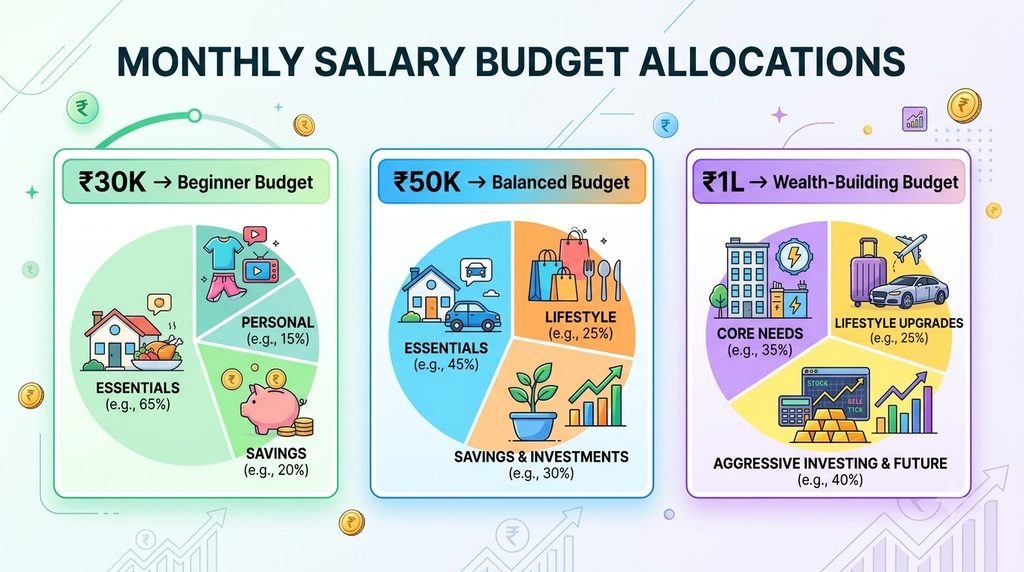
₹30K vs ₹50K vs ₹1L Salary: Quick Comparison
| Monthly Take-Home | Example Needs | Example Wants | Financial Goals |
|---|---|---|---|
| ₹30,000 | ₹16,000 | ₹6,000 | ₹7,000 |
| ₹50,000 | ₹25,000 | ₹12,000 | ₹12,000 |
| ₹1,00,000 | ₹45,000 | ₹20,000 | ₹30,000 |
These are illustrative examples, not fixed recommendations.
Someone supporting parents may need a completely different budget from someone living at home.
Similarly, someone paying a large EMI will have a different financial plan from someone with no debt.
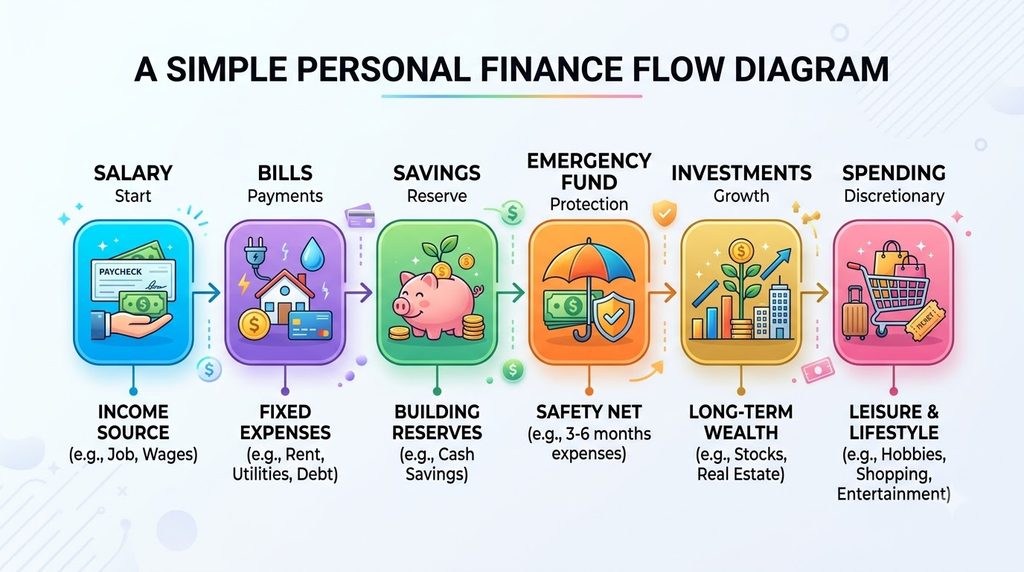
A Simple Salary-Day Routine
Here’s a routine you can repeat every month.
Day 1: Salary Arrives
Check your take-home amount.
Day 1–2: Move Savings
Transfer your planned savings before discretionary spending begins.
Day 2–3: Pay Fixed Expenses
Take care of:
- Rent
- EMIs
- Bills
- Insurance
- Other fixed commitments
Week 1: Plan Your Variable Spending
Set limits for:
- Food
- Transport
- Shopping
- Entertainment
- Personal spending
Every Week: Check Your Spending
You don’t need to track every rupee obsessively.
A five-minute weekly check can be enough to ask:
“Am I spending according to my plan?”
End of Month: Review
Ask yourself:
- How much did I earn?
- How much did I spend?
- How much did I save?
- Where did I overspend?
- What should I change next month?
That’s your personal finance feedback loop.
Common Salary Management Mistakes to Avoid
1. Spending First and Saving Whatever Is Left
This usually results in little or no savings.
Better: Save first.
2. Treating Credit Limit as Income
A ₹1 lakh credit-card limit doesn’t mean you have ₹1 lakh to spend.
It is borrowed purchasing power.
3. Increasing Lifestyle With Every Raise
Don’t let every increment disappear into new expenses.
4. Ignoring Small Recurring Expenses
₹299 here.
₹499 there.
₹999 somewhere else.
Recurring subscriptions can quietly become a significant monthly expense.
5. Having No Emergency Fund
One unexpected expense can force you to borrow money.
6. Investing Without Understanding the Product
Don’t invest because something is trending.
Learn first.
7. Comparing Your Lifestyle With Others
Someone else’s car, phone or holiday doesn’t tell you anything about their finances.
Look at your own numbers.
The 5-Account Method for Easier Salary Management
If managing one bank account feels messy, you can conceptually divide your money into five buckets:
1. Bills Account
Rent, utilities, EMIs and other fixed expenses.
2. Daily Spending Account
Food, transport and everyday expenses.
3. Savings Account
Emergency fund and short-term goals.
4. Investment Account
Long-term investments.
5. Fun Account
Entertainment, shopping and discretionary spending.
You don’t necessarily need five physical bank accounts.
You can simply use separate mental buckets or suitable account structures.
The purpose is to make your money visible and intentional.
Your Salary Management Checklist
Before spending your next salary, ask:
- Do I know my actual take-home pay?
- Have I planned my essential expenses?
- Have I separated needs from wants?
- Have I saved something first?
- Am I building an emergency fund?
- Are my EMIs manageable?
- Am I tracking recurring subscriptions?
- Am I saving for specific goals?
- Have I started learning about investing?
- Have I avoided unnecessary lifestyle inflation?
- Do I have some money left as a monthly buffer?
If you can answer “yes” to most of these, you’re already moving toward better money management.
Final Thoughts: Your Salary Needs a Plan
You don’t need to earn ₹1 lakh a month to start managing money properly.
You can start with ₹20,000.
You can start with ₹30,000.
You can start with your very first salary.
The important thing is to build the habit early.
Earn → Plan → Spend → Save → Protect → Invest → Review
That’s the basic cycle of good salary management.
Your goal shouldn’t be to stop enjoying your money.
Your goal should be to enjoy today’s money without sacrificing tomorrow’s financial security.
Start small.
Build an emergency fund.
Control unnecessary spending.
Be careful with debt.
Increase your savings when your income increases.
And most importantly, learn how money actually works.
Because a bigger salary can improve your life — but better money management determines what you do with it.