
Getting your salary every month feels great—until rent, groceries, subscriptions, shopping, eating out and bills start eating into it.
Before you know it, payday arrives again and you wonder:
This is where the 50/30/20 rule can help.
The 50/30/20 rule is a simple budgeting method that divides your take-home salary into three broad categories:
- 50% for needs
- 30% for wants
- 20% for savings and debt repayment
It isn’t a strict financial law. Think of it as a starting framework that helps you understand where your money should ideally go.
For someone earning ₹30,000 per month, someone earning ₹50,000 and someone earning ₹1,00,000, the actual numbers will look very different. And in India, the rule may need to be adjusted depending on rent, family responsibilities, EMIs, city and income.
Let’s break it down.
What Is the 50/30/20 Rule?
The 50/30/20 rule is a budgeting strategy that suggests dividing your monthly take-home income into three categories:
| Category | Percentage | What it covers |
|---|---|---|
| Needs | 50% | Essential expenses |
| Wants | 30% | Lifestyle and entertainment |
| Savings & Debt | 20% | Savings, investments and debt repayment |
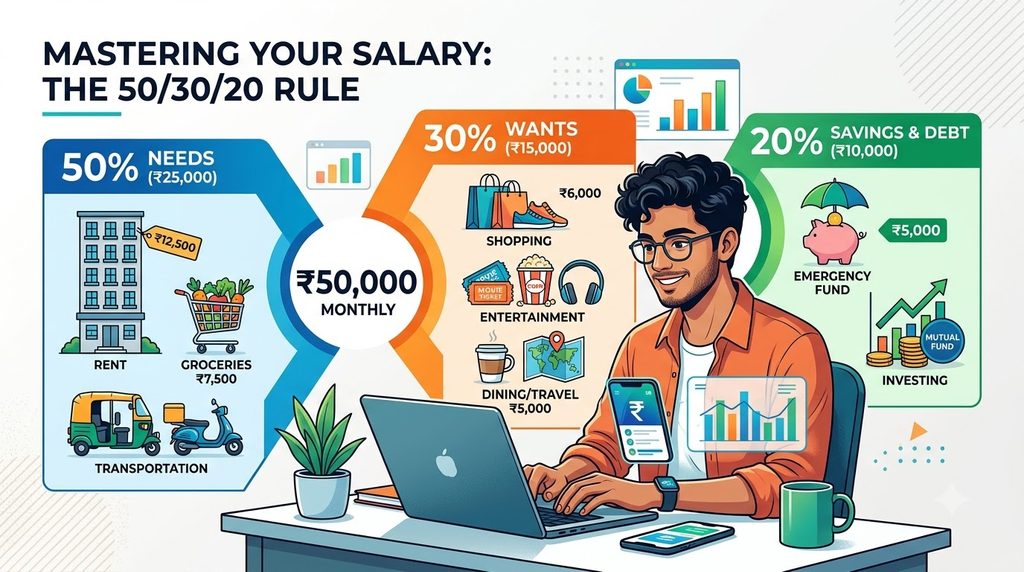
For example, if your monthly take-home salary is ₹50,000:
- ₹25,000 → Needs
- ₹15,000 → Wants
- ₹10,000 → Savings and debt repayment
The idea is simple: you don’t need to track every rupee forever. Instead, you create broad limits for different types of spending.
The basic formula
Take-home salary × percentage = monthly allocation
So:
₹50,000 × 50% = ₹25,000 for needs
₹50,000 × 30% = ₹15,000 for wants
₹50,000 × 20% = ₹10,000 for savings and debt
The important part is that you should generally use your take-home pay, not your CTC or gross salary.
What Does 50/30/20 Actually Mean?
Let’s understand each category before looking at the salary examples.
1. 50% for Needs
Needs are expenses you realistically cannot avoid.
These are the things required to live, work and meet your basic financial obligations.
Examples include:
- Rent
- Groceries
- Electricity
- Water
- Basic internet
- Mobile bill
- Transportation to work
- Essential medicines
- Health insurance premiums
- Basic household expenses
- Minimum loan or EMI payments
If you earn ₹50,000, the traditional 50/30/20 framework gives you:
₹25,000 for needs.
But this doesn’t mean you must spend exactly ₹25,000.
If your essential expenses are ₹20,000, that’s actually a good thing. The extra ₹5,000 could potentially go toward savings or another financial goal.
What is NOT a need?
This is where budgeting gets interesting.
Ordering Swiggy because you don’t feel like cooking is usually a want, not a need.
A basic mobile plan may be a need.
Paying extra for a premium phone plan because you want more entertainment subscriptions is a want.
A bus or metro ride to work may be a need.
Taking an expensive cab every day because it’s more comfortable may be a want.
The difference isn’t always black and white.
2. 30% for Wants
Wants are the things that make life more enjoyable but aren’t essential for survival.
Examples include:
- Eating at restaurants
- Food delivery
- Movies
- Gaming
- OTT subscriptions
- Shopping
- Travel
- Concerts
- Expensive hobbies
- Premium memberships
- New gadgets
- Cafés
- Weekend outings
- Non-essential subscriptions
If your take-home salary is ₹50,000, the 30% allocation would be:
₹15,000 for wants.
This is important because budgeting shouldn’t mean eliminating all fun.
A budget that tells you to never eat out, never travel and never buy anything you enjoy probably won’t last.
The 30% category gives you permission to spend money on things you enjoy—within a limit.
3. 20% for Savings and Debt
The final 20% is for improving your financial future.
This can include:
- Emergency fund
- Bank savings
- Recurring deposits
- Fixed deposits
- Mutual fund investments
- SIPs
- Retirement investments
- Long-term goals
- Extra loan payments
- Credit card debt repayment
For a ₹50,000 salary:
20% = ₹10,000 per month.
You could divide that ₹10,000 between multiple goals.
For example:
| Goal | Amount |
|---|---|
| Emergency fund | ₹4,000 |
| SIP/investment | ₹4,000 |
| Short-term goal | ₹2,000 |
| Total | ₹10,000 |
The exact split depends on your financial situation.
If you have expensive debt, paying it down may be more important than aggressively investing.
50/30/20 Rule for a ₹30,000 Salary
Let’s make the rule practical.
Suppose your monthly take-home salary is ₹30,000.
The traditional 50/30/20 split looks like this:
| Category | Percentage | Amount |
|---|---|---|
| Needs | 50% | ₹15,000 |
| Wants | 30% | ₹9,000 |
| Savings & Debt | 20% | ₹6,000 |
| Total | 100% | ₹30,000 |
Example monthly budget
Imagine you live with your family and don’t pay rent.
Your monthly expenses could look something like:
Needs
- Transport: ₹3,000
- Groceries/household contribution: ₹5,000
- Mobile/internet: ₹1,000
- Insurance/medical: ₹1,000
- Other essentials: ₹5,000
Total needs: ₹15,000
Wants
- Eating out: ₹3,000
- Entertainment: ₹1,500
- Shopping: ₹2,000
- Hobbies: ₹1,000
- Miscellaneous: ₹1,500
Total wants: ₹9,000
Savings
- Emergency fund: ₹3,000
- SIP/investment: ₹2,000
- Short-term goal: ₹1,000
Total savings: ₹6,000
That’s the 50/30/20 rule in action.
But what if you pay rent?
This is where the traditional rule can become difficult.
If you’re earning ₹30,000 and paying ₹12,000–₹15,000 in rent, spending only ₹15,000 on all your needs may be unrealistic.
And that’s okay.
A budget should fit your life—not force your life to fit a budget.
50/30/20 Rule for a ₹50,000 Salary
Now let’s increase the monthly take-home salary to ₹50,000.
| Category | Percentage | Amount |
|---|---|---|
| Needs | 50% | ₹25,000 |
| Wants | 30% | ₹15,000 |
| Savings & Debt | 20% | ₹10,000 |
| Total | 100% | ₹50,000 |
Example
Suppose you live in a city and rent a room or apartment.
Your budget could look like:
Needs — ₹25,000
- Rent: ₹12,000
- Groceries: ₹4,000
- Transport: ₹3,000
- Utilities: ₹2,000
- Phone/internet: ₹1,000
- Insurance/medical/other essentials: ₹3,000
Wants — ₹15,000
- Eating out and food delivery: ₹4,000
- Shopping: ₹3,000
- Entertainment/subscriptions: ₹2,000
- Weekend activities: ₹3,000
- Hobbies/miscellaneous: ₹3,000
Savings & debt — ₹10,000
- Emergency fund: ₹4,000
- SIP/investments: ₹4,000
- Short-term goal/debt repayment: ₹2,000
This gives you a balance between living today and preparing for tomorrow.
50/30/20 Rule for a ₹1,00,000 Salary
Now let’s look at a ₹1 lakh monthly take-home salary.
The traditional allocation would be:
| Category | Percentage | Amount |
|---|---|---|
| Needs | 50% | ₹50,000 |
| Wants | 30% | ₹30,000 |
| Savings & Debt | 20% | ₹20,000 |
| Total | 100% | ₹1,00,000 |
At this income level, however, you may have more flexibility.
For example, if your needs are only ₹35,000, you don’t necessarily need to spend the remaining ₹15,000 on wants.
You could increase your savings rate.
An alternative could be:
| Category | Percentage | Amount |
|---|---|---|
| Needs | 40% | ₹40,000 |
| Wants | 25% | ₹25,000 |
| Savings & Investments | 35% | ₹35,000 |
| Total | 100% | ₹1,00,000 |
This is one of the biggest lessons about budgeting:
50/30/20 is a guideline, not a target you must spend.
If you can comfortably save 30%, 35% or 40%, there’s no reason to deliberately spend more just because the rule says “30% wants.”
₹30K vs ₹50K vs ₹1 Lakh: 50/30/20 Comparison
Here’s the entire framework at a glance:
| Monthly Take-Home Salary | Needs (50%) | Wants (30%) | Savings/Debt (20%) |
|---|---|---|---|
| ₹30,000 | ₹15,000 | ₹9,000 | ₹6,000 |
| ₹40,000 | ₹20,000 | ₹12,000 | ₹8,000 |
| ₹50,000 | ₹25,000 | ₹15,000 | ₹10,000 |
| ₹60,000 | ₹30,000 | ₹18,000 | ₹12,000 |
| ₹75,000 | ₹37,500 | ₹22,500 | ₹15,000 |
| ₹1,00,000 | ₹50,000 | ₹30,000 | ₹20,000 |
This table can also help you quickly create a rough monthly budget based on your income.
How Much Should I Save Every Month?
There isn’t one percentage that works for everyone.
The 50/30/20 rule suggests 20%, but your ideal savings rate depends on factors such as:
- Your income
- Rent
- Family responsibilities
- Existing debt
- Emergency savings
- Age
- Financial goals
- Job stability
- Upcoming expenses
For example:
Someone earning ₹30,000 and supporting their family may struggle to save 20%.
Someone earning ₹1,00,000 and living with their parents may potentially save far more than 20%.
Instead of asking:
“Am I saving exactly 20%?”
Ask:
“Am I consistently spending less than I earn and increasing my savings as my income grows?”
That’s a much healthier way to think about money.
Does the 50/30/20 Rule Work in India?
Yes—but not perfectly for everyone.
The biggest challenge is that living costs vary dramatically across India.
Someone living with their parents in a smaller city may have very low housing costs.
Someone renting alone in Mumbai, Bengaluru, Delhi or another expensive urban area may spend a large portion of their income on rent.
Family responsibilities can also change the equation.
You may be paying for:
- Parents’ expenses
- Siblings’ education
- Healthcare
- Home loans
- Personal loans
- Family insurance
- Children’s education
- Household expenses
In these situations, a strict 50% needs limit may simply be unrealistic.
That’s why you should adapt the framework instead of abandoning budgeting altogether.
When the 50/30/20 Rule Doesn’t Work
1. You live in an expensive city
If rent alone consumes 35–40% of your salary, keeping all needs below 50% becomes difficult.
In this case, try a modified budget.
For example:
60/20/20
- 60% needs
- 20% wants
- 20% savings
The goal is still to protect your savings.
2. You have significant debt
Suppose you have high-interest credit card debt.
Following the rule and spending 30% of your salary on shopping and entertainment while carrying expensive debt isn’t necessarily a good idea.
You may temporarily use:
50% Needs / 20% Wants / 30% Debt & Savings
Once your debt is under control, you can rebalance your budget.
3. You’re supporting your family
If you’re responsible for household expenses, the standard 50% needs category might be too low.
Your budget could look more like:
65/15/20
- 65% needs and family expenses
- 15% wants
- 20% savings
Again, there is nothing wrong with this.
4. You’re a student or earning an entry-level salary
If you’re earning ₹20,000–₹30,000 and living independently, 50% for needs might not be realistic.
Instead, focus on creating some savings habit, even if it’s only 5–10% initially.
Saving ₹2,000 every month consistently can be more useful than creating an unrealistic budget that you abandon after two weeks.
5. Your income changes every month
Freelancers, creators, business owners and people with variable income may not benefit from a fixed monthly percentage based on one salary.
Instead, calculate your average income over several months and prioritize:
- Essential expenses
- Emergency savings
- Taxes and mandatory payments
- Long-term savings
- Lifestyle spending
50/30/20 Isn’t the Only Budgeting Rule
Different people need different budgeting systems.
Here’s how a few popular approaches compare:
| Method | Basic idea | Best for |
|---|---|---|
| 50/30/20 | 50% needs, 30% wants, 20% savings | Beginners |
| 70/20/10 | 70% expenses, 20% savings, 10% other/debt/giving | Simple budgeting |
| Zero-based budget | Give every rupee a purpose | Detailed planners |
| Pay yourself first | Save before spending | People who struggle to save |
| Envelope method | Set spending limits for categories | Overspenders |
For beginners, 50/30/20 is often easier to understand because you don’t need to track dozens of categories.
How to Actually Implement the 50/30/20 Rule
Knowing the rule isn’t enough.
You need a system.
Step 1: Calculate your take-home salary
Don’t use your CTC.
Look at the amount that actually reaches your bank account each month.
For example:
Take-home salary = ₹50,000
Step 2: Calculate your three limits
For ₹50,000:
Needs = ₹25,000
Wants = ₹15,000
Savings/debt = ₹10,000
Step 3: Track your expenses for one month
Don’t change everything immediately.
For one month, simply observe where your money goes.
Look at:
- Bank statements
- UPI transactions
- Credit card statements
- Cash spending
- Subscriptions
You might discover that ₹3,000–₹5,000 is disappearing into small purchases.
Step 4: Automate your savings
This is one of the easiest ways to make the system work.
Instead of waiting until the end of the month to save whatever is left, move your planned savings early.
For example:
Salary arrives → ₹10,000 automatically goes toward your savings/investment goals.
Then you use the remaining ₹40,000 for expenses.
This is often called paying yourself first.
Step 5: Review your budget every month
Your budget doesn’t need to be perfect.
Maybe your electricity bill is higher one month.
Maybe you travel the next month.
Maybe you receive a bonus.
Adjust accordingly.
The goal is to create a sustainable money system—not to win a budgeting competition.
A Simple 50/30/20 Budget Template
You can use this template every month:
Income
Take-home salary: ₹________
Needs — 50%
- Rent: ₹________
- Groceries: ₹________
- Utilities: ₹________
- Transport: ₹________
- Insurance: ₹________
- Healthcare: ₹________
- EMI/minimum debt payments: ₹________
Total needs: ₹________
Wants — 30%
- Eating out: ₹________
- Shopping: ₹________
- Entertainment: ₹________
- Subscriptions: ₹________
- Travel: ₹________
- Hobbies: ₹________
Total wants: ₹________
Savings & Debt — 20%
- Emergency fund: ₹________
- Investments: ₹________
- Retirement: ₹________
- Extra debt payment: ₹________
- Short-term goals: ₹________
Total savings/debt: ₹________
At the end of the month:
Income − Expenses = Remaining money
If you’re consistently ending the month with zero savings, it’s time to review your spending.
The Biggest Mistake: Treating 30% Wants as a Spending Target
This deserves special attention.
The 50/30/20 rule doesn’t mean:
“You should spend 30% of your salary on wants.”
It means:
“Try to keep wants within roughly 30% of your income.”
There’s a big difference.
If you earn ₹1,00,000 and spend only ₹15,000 on wants, that’s perfectly fine.
You don’t need to find ways to spend the remaining ₹15,000.
You could save or invest it instead.
What If You Can’t Save 20%?
Don’t give up.
Start with what you can afford.
For example:
Salary: ₹30,000
Instead of saying:
“I can’t save ₹6,000, so budgeting is pointless.”
Try:
“I can save ₹2,000 this month.”
That’s still ₹24,000 saved over a year, before considering any investment returns.
As your income increases, increase the amount you save.
A useful goal is:
Increase your savings rate when your salary increases.
If your salary goes from ₹40,000 to ₹50,000, don’t automatically increase your lifestyle by ₹10,000.
You could put some of that increase toward your financial goals.
50/30/20 Rule: Pros and Cons
| Advantages | Limitations |
|---|---|
| Very easy for beginners | Doesn’t fit every income level |
| Creates spending boundaries | Rent can make 50% needs unrealistic |
| Encourages saving | Doesn’t account for every financial goal |
| Allows money for fun | Family responsibilities vary |
| Easy to calculate | Variable income can complicate it |
| Doesn’t require detailed tracking | Different cities have different living costs |
The biggest advantage is simplicity.
The biggest limitation is one-size-fits-all thinking.
Frequently Asked Questions About the 50/30/20 Rule
Is the 50/30/20 rule good for beginners?
Yes. It can be a useful starting point because it’s simple and doesn’t require you to track every small expense.
Once you become comfortable with budgeting, you can create a more detailed system.
Is the 50/30/20 rule based on salary before or after tax?
Use your take-home income—the money you actually receive after applicable deductions.
For example, if your annual CTC looks impressive but your monthly take-home salary is ₹50,000, base your budget on ₹50,000.
Can I save more than 20%?
Absolutely.
If your essential expenses are low and your financial situation allows it, saving 25%, 30% or more can accelerate your financial goals.
The 20% figure is a guideline, not a maximum.
What counts as a need in the 50/30/20 rule?
Needs are essential expenses such as housing, basic food, utilities, necessary transportation, healthcare and minimum debt payments.
Is shopping a need or a want?
Basic necessities such as essential clothing can be considered needs. Shopping for non-essential clothes, gadgets and accessories generally falls under wants.
The distinction depends on the situation.
Does EMI count as a need?
Minimum required debt payments are generally treated as needs. However, extra debt repayment can be included in the savings/debt category.
Can I use the 50/30/20 rule with ₹20,000 salary?
You can use it as a starting framework, but it may not be realistic if your essential expenses are high.
For lower incomes, the priority should be covering essentials, avoiding expensive debt and building even a small emergency fund.
Should I follow 50/30/20 exactly?
No.
Think of it as a framework rather than a rule you can fail.
Your actual percentages may be 60/20/20, 55/25/20, 65/15/20 or something completely different.
The best budget is one you can actually maintain.
Final Takeaway: Use the Rule, Don’t Let the Rule Control You
The 50/30/20 rule is popular because it makes budgeting easy.
Instead of asking yourself where every single rupee should go, you start with three simple questions:
Am I spending enough on my needs?
Am I keeping my lifestyle spending under control?
Am I consistently saving for my future?
For a ₹30,000 salary, that could mean roughly ₹15,000 for needs, ₹9,000 for wants and ₹6,000 for savings.
For ₹50,000, it becomes ₹25,000, ₹15,000 and ₹10,000.
For ₹1,00,000, it becomes ₹50,000, ₹30,000 and ₹20,000.
But your circumstances matter.
If you’re paying high rent, supporting your family, dealing with debt or earning an irregular income, modify the percentages instead of abandoning the idea of budgeting.
The real goal isn’t to achieve a perfect 50/30/20 split.
The goal is to spend intentionally, avoid lifestyle inflation, build savings and make your money work toward the life you actually want.
Start with the 50/30/20 rule.
Then make it your own.